Data released by the General Administration of Customs on June 7th shows that in May of this year, China's import and export value was 3.45 trillion yuan, with a slight increase of 0.5%. Among this, trade exports were 1.95 trillion yuan, a decrease of 0.8%; imports were 1.5 trillion yuan, an increase of 2.3%.
In terms of US dollars, the import and export value was $501.19 billion, a decrease of 6.2%. Exports were $283.5 billion, a decrease of 7.5%, turning negative again after two months; imports were $217.69 billion, a decrease of 4.5%.
The significant discrepancy between calculations in yuan and US dollars is fundamentally due to the substantial devaluation of the yuan in May.
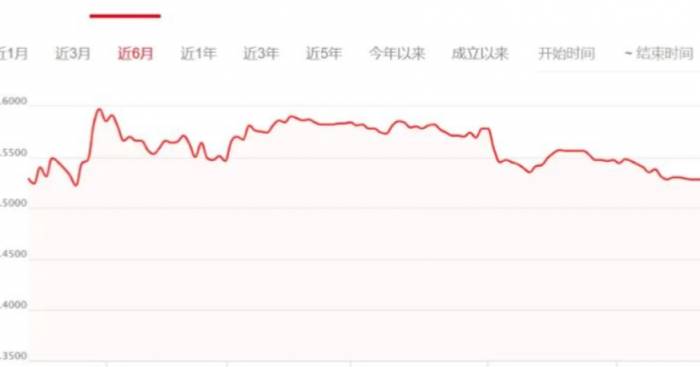
In May 2023, the yuan depreciated against the US dollar by 2.77%. This increase and decrease inevitably had a significant impact on data statistics.
Of course, theoretically speaking, a depreciation of the yuan is beneficial for foreign trade exports. Even under these favorable conditions, trade exports in May still showed a decrease when calculated in yuan, which is enough to see how bleak the foreign trade situation was in May.
We can only say that in May, the trade data was much worse than imagined, and there is a certain reason for the poor stock market performance.
In addition, if we really want to find an excuse, there is one, that is, the increase in foreign trade export data in May 2022 was too large.
In 2022, the domestic economy was greatly affected by the epidemic. To be honest, during the three years of the epidemic since 2020, China's trade exports have always been very strong, and the fundamental reason is the economic stimulus measures taken by developed economies led by the United States.
In April 2022, due to domestic epidemic factors, there was a short-term impact. Calculated in yuan, the import and export growth rate for that month was only 0.1%, and orders were obviously backlog in May 2022, because the total value of import and export trade in May increased by 9.6%.
It is not difficult for us to find that to analyze trade import and export data more accurately, at least the two months of April and May should be looked at together to be relatively objective.This implies that behind the high growth of import and export data in April 2023, the reality is not as splendid as it seems.
Since 2023 is a year when the economy is relatively less affected by the pandemic after the implementation of Class B management, it is much more reliable to carefully consider the absolute data of 2023 than to think about the year-on-year growth rate. Because, low base high growth is just a number game.
The probability of weak growth in foreign trade exports in June and the third quarter is still relatively large, and there may be a recovery in the fourth quarter. However, there are still many pessimistic factors.
Over the past three years, we have experienced a process from a surge in international demand to a gradual cooling down.
The reason for the surge in demand is nothing more than the developed economies led by the United States starting a large-scale monetary easing mode, "helicopter money" to consume the world, allowing China's foreign trade exports to achieve high growth in the three years of the pandemic.
Aggressive interest rate hikes plus a Ukraine crisis, a series of operations fierce as a tiger, have basically brought international demand back to before the large-scale monetary easing, and the import and export data in May is actually the most true portrayal.
The problem is that developed economies such as Europe and the United States have not yet emerged from inflation, and the probability of some developed economies entering a recession in the second half of 2023 is relatively large, which is definitely not good news for China's trade exports.
With the impact of sluggish international demand, the downward pressure on the domestic economy remains relatively large. At present, consumption and real estate have not been able to achieve a good pull on the economy. Under the unclear global macroeconomic situation, most people are likely to maintain a cautious consumption attitude in the second half of the year.
It has been noticed that many observers hope to take further stimulating actions, for example, they believe that "reducing reserves and interest rates" may happen in the second half of the year.
A particularly important issue to point out is that under the high interest rate situation in the United States, if we continue to adopt further monetary easing, it may not necessarily be a good thing, and we need to prevent systemic risks from occurring.Monetary easing has actually led to negative impacts. The fundamental reason for the "prepayment wave" since April is that interest rates have fallen too quickly. When things reach an extreme, they tend to reverse, which is detrimental to the stable growth of the economy.
Overall, the economic recovery after the domestic epidemic has encountered a slight recession in the world economy. We need to be more tolerant in the next few months. For A-shares, the structural market will continue.




















Leave a Comment