A seismic shift in energy is quietly underway!
There is a revolutionary energy technology that will overturn the current energy structure. The energy obtained from this technology will be able to completely replace fossil fuels such as oil and natural gas in the future. At that time, China will no longer need to import oil and natural gas from the Middle East, Russia, and other places, and the energy mission of oil, coal, and others will come to an end.
This energy-harvesting technology is "controlled nuclear fusion," which is more powerful than the "nuclear fission" technology used in current nuclear power and nuclear power generation, releasing more energy. With just 1 gram of fuel, the energy obtained from fusion is equivalent to the combustion of 8 tons of oil, without producing carbon dioxide and other greenhouse gases, and nuclear waste is also more controllable.
In recent years, the international community has successively achieved magnetic confinement and laser inertial confinement nuclear fusion, getting closer to the future energy, and the international community has once again set off a wave of research and development.
So, where has China reached in the research and development of "controlled nuclear fusion"?
Zhan Wenlong has served as the director of the Institute of Modern Physics of the Chinese Academy of Sciences, the vice president of the Chinese Academy of Sciences, and the vice chairman of the 27th and 28th Executive Committee of the International Union of Pure and Applied Physics (IUPAP), and is an academic leader in this field.
1
Controlled nuclear fusion is expected to
End fossil energy
What is nuclear fusion? What is "controllable" nuclear fusion?It is understood that currently, nuclear fusion energy involves heating two isotopes of hydrogen (usually deuterium and tritium) to extremely high temperatures, causing the atomic nuclei to fuse into lighter helium and neutrons, with the tiny mass difference being converted into enormous energy according to Einstein's mass-energy equivalence. The term "controllable" implies that people can control the initiation and cessation of nuclear fusion, and the reaction rate and scale of nuclear fusion can be regulated at any time, equivalent to a controllable "artificial sun."
Data indicates that the energy released by nuclear fusion materials is much greater than the energy released by the same mass of nuclear fission materials. As one of the materials, deuterium is widely present in nature, with 30 milligrams of deuterium in every liter of seawater, and the energy produced by the fusion of 30 milligrams of deuterium is equivalent to that of 300 liters of gasoline.
NBD: For a long time, why has controllable nuclear fusion been regarded as the ultimate solution to human energy problems?
Zhan Wenlong: First, compared to existing energy sources, the outstanding advantage of nuclear fusion is its environmental friendliness. Compared to fossil fuels, nuclear fusion does not produce greenhouse gases such as carbon dioxide. Compared to existing nuclear fission, on the one hand, the waste produced by controllable nuclear fusion has a shorter radioactive decay life, from hundreds of thousands to millions of years, reduced to possibly decades to 100 years or less, making waste management more controllable; on the other hand, these wastes release less heat, further reducing safety risks.
Secondly, the energy density produced by nuclear fusion is very high, and the energy release efficiency of nuclear fusion far exceeds that of traditional chemical energy combustion, with a difference of up to a million times. For example, the energy released by the reaction of tritium, another material for fusion, with neutrons and lithium-6 is a million times higher than that of lithium batteries. This means that a relatively small amount of fuel can produce a huge amount of energy. The energy obtained from the fusion of 1 gram of deuterium-tritium fuel is equivalent to the energy from burning 8 tons of oil.
In addition, the development of controllable nuclear fusion technology is not only expected to solve energy problems, but also to promote the development of related technical fields during the research process. For example, it may bring more innovative applications to superconductivity and nuclear medicine, making future tumor treatment and high-precision diagnosis more widely available and affordable. Currently, a course of treatment may cost more than 200,000 yuan, but in the future, from the perspective of equipment manufacturing, it may be reduced to around 100,000 yuan. The advancement of accelerator technology will also enable the miniaturization of equipment, benefiting a broader population.
NBD: At present, the proportion of global fossil energy still exceeds 80%. Can the application of controllable nuclear fusion completely replace fossil fuels such as coal, oil, and natural gas?
Zhan Wenlong: From an energy perspective, after large-scale application, the use of controllable nuclear fusion can basically replace the use of fossil fuels such as oil and natural gas, thereby completely changing the form of energy utilization. In the future, fossil resources will be presented in the form of raw materials for the chemical industry, such as extracting various basic chemical raw materials from fossil energy for the production of chemical products like fibers, plastics, and rubber.
Similar to the historical steam and electricity revolutions, controllable nuclear fusion, as a potential low-carbon energy revolution, will have a greater impact on economic and social development in the application of secondary and tertiary energy, bringing a disruptive change to the energy structure and power systems of future societies.
Taking the current utilization of nuclear energy (nuclear fission) as an example, in addition to nuclear power generation, nuclear technology has also been promoted and applied in military and medical fields. In the military field, large vessels such as nuclear submarines and aircraft carriers use nuclear fission reactions to provide power. In space exploration, despite the high cost, nuclear energy (such as radioisotope thermoelectric generators) has been used in Mars and moon exploration missions. Nuclear energy is also used in small devices, such as isotope batteries in cardiac pacemakers.NBD: Can future controllable nuclear fusion devices also be miniaturized? Could we eventually see the emergence of tools such as nuclear-powered aircraft and nuclear-powered cars?
Zhan Wenlong: Although technology is continuously evolving, using nuclear energy as a power source for aircraft is theoretically feasible. However, the prerequisite for using nuclear energy in aircraft and other flying vehicles is whether "absolute nuclear safety" can be guaranteed. The probability of a nuclear power accident is one in ten million, which is far less than the probability of an aircraft accident. In the event of an aircraft accident, the induced consequences would be much more severe than conventional accidents.
In the future, to commercially utilize controllable nuclear fusion for energy supply, in addition to solving the sustainable cycle of fusion fuel and the development of materials resistant to fusion-fast neutron radiation, economic viability must certainly be considered. Up to now, we have mainly used the magnetic confinement approach to achieve controllable nuclear fusion. In this case, the scale of the nuclear fusion reactor would be very large, making it difficult to improve economic viability and the cost-performance ratio. Therefore, in terms of engineering construction, we can only build while improving technology and making incremental innovations.
Global scientists are working towards achieving nuclear fusion by 2035 to 2040. Since the 1990s, the scientific principles of magnetically confined controllable nuclear fusion have been confirmed. Currently, it has entered the stage of engineering feasibility research. The operation of a batch of devices represented by the International Thermonuclear Magnetic Confinement Fusion Facility (ITER) will be a new milestone for controllable fusion as a low-carbon energy source. Government and private investments are expected to rapidly push the industry into the commercialization phase.
NBD: China has committed to achieving carbon neutrality by 2060, and energy transformation is key to achieving this goal. Do you think controllable nuclear fusion can be achieved by 2060?
Zhan Wenlong: To my knowledge, the international community is mostly optimistic about China's goal of achieving carbon neutrality by 2060. Although it is expected that by 2060, nuclear fusion may not yet be able to take the leading role, and the progress in nuclear fission technology is still insufficient to meet the scale requirements for carbon neutrality, China's momentum in the development of clean energy fields such as solar, wind, hydropower, and nuclear power is strong. The comprehensive use of various energy sources is expected to effectively support the achievement of the carbon neutrality goal. In addition, in the field of nuclear power, with technological progress and scale expansion, nuclear power will gradually replace coal power and become an important component of stable power supply in the power grid.
I believe that it is unrealistic to rely on controllable nuclear fusion technology to achieve large-scale power supply before 2060. Currently, the global energy supply still mainly depends on fossil energy and some renewable energy sources (such as wind, solar, and hydropower). The International Energy Agency forecasts that the global scale of nuclear power will increase by 2 to 3 times. However, controllable nuclear fusion technology will definitely make progress, and it is expected to reach the demonstration stage, that is, to show its ability to produce stable electricity. Whether it can achieve large-scale commercial application is still unknown.
NBD: What is the progress in global controllable nuclear fusion technology research? When can humanity truly use energy obtained from this technology?Zhan Wenlong: From the perspective of technological maturity, we can categorize the development of a scientific and research technology from inception to commercial-scale application into nine levels. Currently, global nuclear fusion technology is at approximately level 4 to 5. To reach the commercial application level of 9, issues related to fuel, materials, safety, reliability, and economics need to be addressed. It is anticipated that it will take three to five decades to transition from basic research to more stable and reliable technology, reaching a demonstration application level, which is roughly at level 6 to 7.
At present, scientists worldwide are striving to achieve nuclear fusion by 2035 to 2040, but there are still many challenges to overcome before it can be transformed into commercial applications, such as economic viability. By 2060, the economic competitiveness of nuclear fusion power compared to other energy sources remains uncertain, as solar power is already considered "dirt cheap," with the lowest cost already reaching 0.1 yuan/kWh (without energy storage).
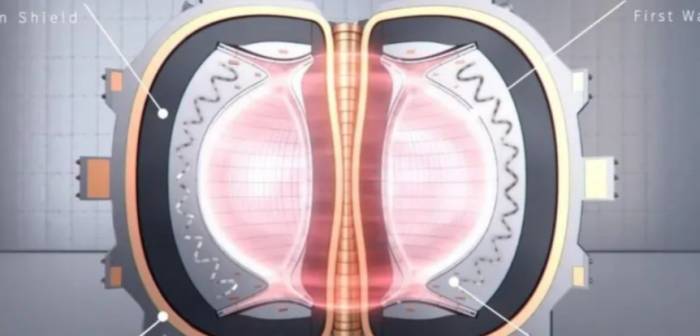
If truly achieved, controlled nuclear fusion represents an infinite source of energy. It is understood that currently, magnetic confinement fusion and inertial confinement fusion are considered two important methods for achieving controlled nuclear fusion. Among them, magnetic confinement fusion achieves self-sustained burning of deuterium and tritium plasma through low-density, long-duration combustion, and maintains this combustion. To achieve nuclear fusion, high temperature, high density, and a sufficiently long reaction time are required. Only when these three parameters meet certain standards simultaneously can self-sustained nuclear fusion reactions occur, ensuring effective energy release and stable output.
NBD: We generally understand that controlled nuclear fusion is an infinite source of energy, is that correct?
Zhan Wenlong: The slight mass difference before and after a controlled nuclear fusion reaction converts into enormous energy according to Einstein's mass-energy equivalence. Currently, the deuterium-tritium reaction is used, which is the easiest fusion reaction to achieve among all fusion reactions. Although theoretically, deuterium-tritium nuclear fusion can be considered an almost infinite source of energy, deuterium is widely present in nature, and there are abundant deuterium resources in the ocean, often popularized as an "endless" element. However, the actual nuclear fusion reaction involves the combination of deuterium and tritium.
Tritium is a radioactive isotope (with a half-life of about 12.3 years) and is essentially non-existent in nature. Theoretically, one fast neutron released in the deuterium-tritium fusion reaction can react with beryllium to produce two slow neutrons, which can split lithium into helium and tritium, but the technical feasibility requires experimental verification.
Furthermore, the premise of this reaction is having an operating fusion reactor, and a commercial-scale reactor itself also requires a sufficient amount of tritium (more than the current global reserves) to initiate. If the theory of fuel self-sustainability is verified, then controlled nuclear fusion indeed represents an infinite source of energy.NBD: In nuclear fusion reactions, materials need to withstand temperatures as high as hundreds of millions of degrees Celsius, while the materials we currently have can only endure temperatures in the thousands of degrees Celsius. Some people believe that material resistance to high temperatures will become the biggest challenge in controlled nuclear fusion research. Do you agree?
Zhan Wenlong: The resistance of materials to high temperatures seems to be a huge limitation, but it is not the main issue. In magnetic confinement nuclear fusion, particles at high temperatures will ionize into charged particles. Under the constraint of a strong magnetic field, these charged particles do not directly hit the material surface, thus avoiding direct damage to the material from high temperatures. Magnetic confinement containers are made of vacuum pressure materials, and the bigger problem lies in the strong neutron radiation in nuclear fusion. Neutrons are uncharged, and they can penetrate materials and cause radiation damage.
The energy of neutrons produced by the deuterium-tritium reaction is higher than that of existing fission reactions, which puts forward higher requirements for the radiation resistance of materials. So far, there is no real high-intensity fusion neutron source in the world to test materials, so more basic research is needed.
It is worth mentioning that in recent years, China has maintained world records in nuclear fusion research, especially in high-temperature or high-density operation under long-pulse conditions. It has made breakthroughs in technical challenges such as superconducting magnetic confinement. Superconducting materials and large magnets are the main builders in the ITER development, and they have taken the lead in the research and application of high-temperature superconductors and magnets, maintaining a certain level of advancement in the global fusion research field. For example, the EAST has achieved a high-confinement mode plasma operation of 403 seconds for the first time, which has improved its voice in ITER.
NBD: How is the research progress in China's controllable nuclear fusion field? What are the advantages on the international stage?
Zhan Wenlong: In addition to showing a long-lasting advantage in the operation technology of steady-state high-confinement mode plasma, China also has certain advantages in the development and utilization of high-current accelerators. The high-current ion superconducting linear accelerator has a current power ratio that is nearly an order of magnitude higher than the international level, especially achieving stable operation for hundreds of kilowatts for hundreds of hours. The use of accelerator-driven advanced nuclear fission energy systems is a more advanced nuclear power system, which is expected to enter commercial operation ten years later. The high-current ion accelerator technology of the Institute of Modern Physics, Chinese Academy of Sciences, will be capable of developing a strong neutron source that can meet the research of fusion fuel and material development. If it can be included in the "15th Five-Year Plan" national major scientific and technological infrastructure construction, it will take the lead in the international development of fuel self-sustainment and material issues we mentioned earlier.
NBD: Why can China's high-current ion accelerator stand out in the fierce international scientific research competition? When do you expect a significant scientific breakthrough?
Zhan Wenlong: The advantage of our country's socialist system is to concentrate resources to do big things. Especially after the century, the state has increased investment in research, coupled with the talent-strong country strategy, long-term stable basic research and national major scientific and technological infrastructure research and development, breakthroughs in beam physics, improvements in advanced manufacturing levels (digital twin, process and testing levels), and the application of heavy ion therapy have made our country take the lead in ion accelerator research and development on the international stage.
We say that in nuclear fusion research, laser inertial nuclear fusion is a relatively fast-developing controllable inertial fusion method. The U.S. National Fusion Center has successfully triggered gigajoule-scale nuclear fusion reactions using ultra-strong lasers. It is estimated that our country's research and development in this field will also be able to achieve fusion reactions by 2030. However, the efficiency of electricity and laser conversion for this method is relatively low, with less than 5% energy conversion efficiency in the entire process. This means that although laser inertial nuclear fusion has achieved certain successes in experiments, its efficiency is not enough for commercial power generation.
In contrast, the high-current heavy ion inertial fusion driver is recognized by the international academic community as an ideal inertial fusion energy method. The energy conversion efficiency of the high-current heavy ion beam is as high as 30%, with a repetition frequency of ten hertz, the final transmission device of the beam is more than 5 meters away from the target (to avoid being damaged by the explosion), the accelerator can run stably for a long time and is maintainable, and the energy amplification multiple of the heavy ion inertial fusion reaction can reach a thousand times.The challenge of heavy ion inertial fusion lies in achieving an energy density for explosion that is millions of times higher than that required by intense beam accelerators. Since the 1970s, many international researchers have been working on this, but the technological progress in the field of intense beam accelerators has been relatively slow. In the past decade, China has made breakthroughs in the physics of intense beam physics and discovered new properties of high-energy-density matter, leading to more efficient fusion methods. By 2025, the country will complete the construction of a major national science and technology infrastructure, the "High-Intensity Heavy Ion Accelerator Research Facility". Subsequently, heavy ion beams will be able to reach high-energy-density conditions, enabling small-scale fusion "explosions" on the order of kilojoules, marking a new milestone in international heavy ion inertial fusion.
Once small-scale fusion "explosions" are achieved, the next step will focus on scaling up and optimizing the energy conversion process. This includes enhancing the accelerator from kilojoule beam clusters to megajoule beam clusters, improving efficiency, increasing the repetition rate of the beam clusters, and developing high-performance energy collection and conversion systems. The goal is to convert the energy released by nuclear fusion reactions into practical forms of energy, such as electricity, to promote the application of controlled nuclear fusion.




























Leave a Comment