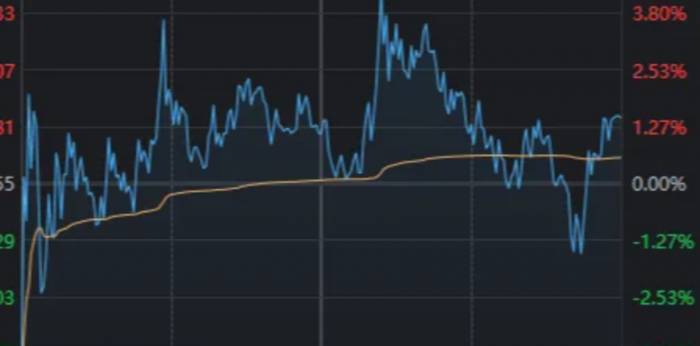
Although I accurately predicted that the short-term peak of this round of "mad bull" market would be reached on the first trading day after the holiday, I did not expect the market to fall so miserably. Today, the ChiNext Index plummeted by more than 5% again, erasing the 17% gain on the 8th within just three days and even falling short by 3%. It's truly a dream-shattering blow for the bull market.
Consider this: if someone had bought in right after the National Day holiday, they would be caught in a nearly 20% loss. Not to mention new investors, even seasoned investors would struggle with such a situation. It's not just a matter of the market reversing to pick up investors; it's more like the market reversing to crush them. The popular big blue account that aggressively promoted the bull market during the holiday has now been permanently banned. The financial sector is not as easy to navigate as it seems.
There is indeed a competition for funds between A-shares, Japanese stocks, emerging markets like India, and U.S. stocks. Before the holiday, when A-shares surged, foreign capital sold off Japanese and Indian stocks and then bought Chinese assets, causing a general decline in the Asia-Pacific market, with only Chinese assets standing out, and U.S. stocks also performed poorly. Then, after the holiday, when A-shares plummeted, U.S. stocks experienced consecutive strong gains.
The global capital is limited. Last year, foreign capital popularized an "ABC strategy," which stands for All But China, shorting Chinese assets while going long on U.S. stocks. This shows that for foreign capital, Chinese assets are in competition with other markets.
In September, when A-shares were still at the bottom, I was bullish on A-shares because I believed in the objective laws of the dollar cycle. The Federal Reserve's interest rate hikes lead to the dollar returning to the U.S., which is bearish for emerging markets. Conversely, when the Federal Reserve cuts interest rates, causing the dollar to flow out, it is bullish for emerging markets.
This round of the A-share "mad bull" market began with the central bank's policy package of 500 billion yuan + 200 billion yuan. The central bank's major move came after the Federal Reserve cut interest rates by 50 basis points, which was not a coincidence. Only after the Federal Reserve cut interest rates did our central bank have policy space.
In the past two weeks, the U.S. has released September non-farm employment data and CPI, both of which exceeded expectations. The Federal Reserve may not cut interest rates in November, which undoubtedly limits the central bank's further policy space.In fact, the US dollar has been strengthening recently, while the offshore RMB exchange rate is depreciating, which has led to a decrease in the attractiveness of Chinese assets to foreign capital.
You might wonder whether the US economic data is genuine or embellished. If the data is not genuine, could it really be just to compete with Chinese assets for funds? If we simply talk about conspiracy theories, it makes sense. However, if the Federal Reserve does not want the dollar to flow out, it could have easily lowered interest rates by 25 basis points in September.
I personally believe that the resilience of the US economy is quite strong, which can be seen from the service industry PMI. Even if the data is embellished, it could be for the election or to manage expectations. As for restricting A-shares, it might be possible but not the main reason.
However, foreign capital is indeed the main driver of the recent ups and downs in A-shares. The surge in A-shares before the holiday was mainly due to foreign hedge funds buying in. Hedge funds are typical short-term capital, making profits from price swings and then leaving. During the National Day holiday, Goldman Sachs and Morgan Stanley were bullish on A-shares, talking about issuing trillions of yuan in government bonds. Foreign capital crazily pushed up Hong Kong stocks and Chinese concept stocks, raising market expectations too high. Then, after the holiday, without policy support, foreign capital began to sell and short, according to a report from Goldman Sachs, hedge funds sold a record amount of Chinese stocks on Tuesday. Hedge funds not only reduced their long positions but also increased their short positions. The amount of long sales was twice that of short sales.
Foreign capital is causing turmoil in A-shares, taking away the pricing power, while domestic capital is going with the flow.
I really feel heartbroken. Heaven knows how low the market confidence was before, and many policies were ignored by the market. Therefore, the confidence recovery brought by this bull market is precious. If this bull market ends like this and traps the already struggling stock investors, I can only say that the next time it will be even more difficult to believe. I hope that the Ministry of Finance can boost market expectations tomorrow.
Finally, let's take a brief look at the market. As of the close, the Shanghai Composite Index fell by 2.55%, and the ChiNext Index plummeted by 5.06%, once breaking below 2100 points. Hong Kong stocks were not open. The turnover of the two markets shrank significantly to 1.58 trillion yuan, with nearly 4,900 stocks falling.

















Leave a Comment